Tuesday, January 26, 2021

The Last Gunfight at the Rice Hotel [Repost]

Editor's note: This article appeared in the Houston Heights Tribune twenty years ago. It was one of the last few articles I wrote for that paper––one that gave me wonderful opportunities to write interesting pieces and explore and develop my skills. Thank you, Sharon and Amy!

I once chanced to hear a tale about a great, great uncle who was killed in a gunfight. I don't remember how or why it came up, but it did. And the story came to me through my aunt, which she heard from her cousin Bernie. So, she had no details other than the duel took place in front of the Rice Hotel sometime in the early 1900s. There were no specific dates or any other forms of substantiation –– but that didn't matter.

The minute the words left her lips, the images and sounds began forming in my mind. The first thing I heard was the "ching" of spurs striking the cobblestone on Texas Avenue to announce each man's footsteps. Coming into imaginary focus was the mental movie of two men squaring-off, the theme from "The Good, The Bad, And the Ugly" steadily playing in my mind. The hands of a nearby clock approach high noon while the men's palms quiver above their holstered pistols. When the music climaxes on the hour-strike of a clock chime, one of the two men flinch. At that moment a deadly race is on to see who draws faster. Only a 100th of a second separates victor and victim.

In the wink of an eye, both barrels clear leather and let loose clouds of smoke and booms of thunder. When the smoke lifts and the echoes fade, one man falls to the street as scarlet billows over the stones and into the spaces between.

My imagination stampeded with this one, which was exactly what my aunt feared. Not that I wished a violent demise on anyone, but if the story were true, wow! What was it that lured this uncle to his fate? All the usual cliches came to mind––gambling, a woman, or simply stupid bravado.

The next morning I was on fire. I needed to know the who, what, when, where, and how. For years, my older brother and I (mostly my brother) had researched family history. But that was primarily on my father's side and, certainly, nothing as exciting as a gunfight had ever surfaced. So my pursuit of this truth began with scant information and the name of a relative with whom I've never spoken.

I found Cousin Bernie listed in the phone book—yes phone book. I dialed the number and waited with anticipation. After a few rings cousin Bernie answered. I introduced myself and explained that I was kin and how we were related.

The Rice Hotel in 1910.
A minute or two into the call I mentioned the story and asked if he knew much more about it. He perked up and explained that his Aunt Maude had only briefly mentioned it to him. What's more, it seemed to Cousin Bernie that it was something she was reluctant to talk about in detail. But, according to Maude, her brother died in the last gunfight at the Rice Hotel around 1905 or 1906. He went on to say that his uncle's name was Jack and that he was buried at the Holy Cross Catholic Cemetery in Dickinson. That seemed to fit because my grandfather was Catholic.

Cousin Bernie and I chatted a bit longer, then he asked me to let him know if I found more. I said I would. My next call was to the cemetery where a nice woman named Lucille answered the phone. Since I had a name and about when he died, Lucille said she should be able to confirm if Uncle Jack was there. She took my phone number and said she would call when she had something.

An hour or so later, Lucille called. She located Uncle Jack within a family plot near the entrance of the cemetery. Along with a map pinpointing the gravesite, she faxed a copy of a ledger showing the precise date of death for Uncle Jack was 2/19/1906.

Here were the first critical pieces of evidence. I had a name, a grave, and an exact date of death. But all they told me was when Uncle Jack died, not how. The Holy Cross file had no death certificate. But Lucille did say Earthman's had prepared other family members for interment. Perhaps they might have done so for Uncle Jack and, if so, they might have a death certificate citing a cause of death.

On the other end of the phone at Earthman Funeral Directors was Peggy. She said it was possible such an old file still existed and that it might contain a copy of the death certificate. However, I’d have to submit a written request for such information. So, I did. I sent a similar request to the state bureau of Vital Statistics as back-up. In either case, it could be weeks before I get results.

With the phone-work done, the next logical step was the library. Surely a gunfight would make the local papers. At the turn of the 20th century, Houston was an exploding metropolis where two newspapers battled for circulation. Somewhere in their pages had to be the story of Uncle Jack and the gunfight at the Rice Hotel.

The first microfiche reel contained the editions I needed for the then Houston Chronicle and Herald. I immediately scanned to February 19th to find an obituary. There it was on page 5—Uncle Jack, or JD as the paper referred to him, was aged 22. He died in the early morning hours at his family residence on Main Street. Services were held that afternoon at 3:00 at Sacred Heart church. It also mentioned interment to be made at the Holy Cross Cemetery. Parents, as well as several brothers and sisters, survived him—one was Aunt Maude.

Now I was really curious. What could have cut short the life of such a young man? With no answer as to cause, I figured if Uncle Jack had been shot, it must have taken place pretty close to February 19th. So, I reviewed all the previous week’s issues.

An editorial on February 17th caught my attention. It called for increasing the punishment for unlawfully carrying weapons, especially pistols. What prompted the argument? Was it a rash of events or a single, isolated incident of gunplay in front of a fine Houston hotel? A detailed search revealed the reporting of only one shooting during the week before February 19. Uncle Jack was not involved. The Chronicle was now a dead end.
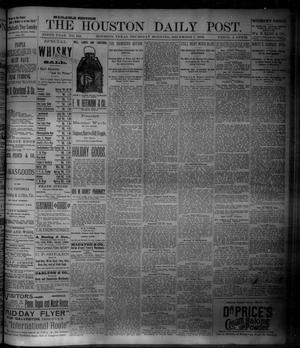
The Houston Daily Post was the morning edition, so Uncle Jack's obituary appeared on February 20th. It was nearly identical to the Chronicle's text. It, too, lacked any clue as to cause of death. Still, I decided to scan the previous week's editions.

The Post had a story about the same shooting as The Chronicle—no other shootings were reported. But The Post did have something new—a Mortuary Report. Each Sunday the paper listed how many died during the previous week. The list was by name and, and it featured causes of death. I'd found the report in the Sunday edition the week before Uncle Jack's death. So, I quickly rolled forward to February 25th.

Twice I looked through the issue before I found it. The small report was buried deep in the inside column just right of the gutter and near the bottom of the page. But the report was there and so was Uncle Jack. His name, his age, where he lay, and, now, how he died were no longer questions to which I sought answers.

By diving into family lore I’d tasted a bit of history while learning a bit about my heritage. More importantly, I was fortunate to have visited with a family member I'd never met before. I am now convinced of one other thing, the next conversation with my aunt should be very, very interesting.

Tuesday, January 5, 2021

God's Gift of Humor

 By Ellen Connelly


A few summers ago St. Peter's had a summer film festival where several of us were asked to come on a Wednesday evening and show our favorite film. It seemed to me to be a very simple, straightforward assignment with no strings attached.  A few days before I was scheduled to make my appearance I overheard Fr. Stockton telling someone about it, and was just short of horrified to learn that the presenter would be leading a discussion with the audience about the religious significance of the film they’d chosen. If you’ve seen Waking Ned Devine you undoubtedly appreciate my concern. (If you haven’t seen it, go rent it) This film includes gambling, nudity, profanity, lying, and sex. (It also includes some spectacular scenery.) It’s one of the funniest movies I’ve ever watched, but probably not what I’d have picked had I realized what was expected.

I tend to enjoy movies and books for the story and have never been good at or enjoyed searching for hidden meanings, nor do I need to find significance in everything ... I’m not likely to be the person who will see the Virgin Mary in a pancake. So this was a real challenge. It was only after viewing the DVD several times, and enjoying it every time, that I felt I’d discovered the message: GOD WANTS US TO LAUGH.

That’s not a conclusion you would come to by reading the Bible. It only mentions laughter forty-two times. (I didn’t count. That’s from Wikipedia). Most of the time laughter is mentioned in Holy Writ it is derisive, as in Psalm 37, “ The Lord laughs at the wicked”, or cynical, as in Genesis when Abraham and Sarah both laugh at the notion they could become parents in their nineties. We even read in Ecclesiastes 7:3 that, “Sorrow is better than laughter, for by sadness of face the heart is made glad.” 

The Bible does talk a lot about joy, but not about any hearty belly laughs. (Unless you count Abraham falling flat on his face when he got the message of his impending fatherhood.)

But does that mean that God has no sense of humor? Surely He must have. Why else would He have given the dog a tail? In Psalm 104, a magnificent paean of praise for all He created, we read that he made whales just to play in the sea. The God who turned water into wine at a wedding obviously wanted people to enjoy themselves. Life includes both sorrow and joy, and just as tears may be our answer to sorrow, laughter is our response to joy. Joy and laughter are good for us. In Proverbs, we read, “A cheerful heart is a good medicine, but a downcast spirit dries up the bones.” 

As I continued to search for something that would explain the religious significance of Waking Ned Devine, I came across this prayer by Edward Hays. It says it all.
“ Father and God of Fools, Lord of clowns and smiling saints, I rejoice in this playful prayer that you are a God of laughter and of tears. Blessed are you, for you have rooted within me the gifts of humor, lightheartedness and mirth. With jokes and comedy you cause my heart to sing as laughter is made to flow out of me. I am grateful that your son, Jesus, who was this world’s master wit, daily invites me to be a fool for your sake, to embrace the madness of your prophets, holy people and saints. I delight in that holy madness which becomes the very medicine to heal the chaos of the cosmos since it calls each of us out of the hum-drumness of life into joy, adventure, and, most of all, freedom. I, who am so tempted to barter my freedom for tiny speckles of honor and power, am filled with gratitude that your son’s very life has reminded me to value only love, the communion with other persons and with you, and to balance honor with humor. With circus bands and organ grinders, with fools, clowns, court jesters and comics, with high-spirited angels and saints, I too join the fun and foolishness of life, so that your holy laughter may ring out to the edges of the universe. 
Blessed are you, Lord my God, who invites me to be a holy fool.”

Amen

_________________________

Ellen Connelly is a most faithful Christian and wonderful aunt. She lived many years in Kerrville, Texas but has since moved to a smaller community outside of San Antonio. Each summer we visit and part of the annual ritual is movie night. Aunt Ellen has a knack for picking gems that even young great-nephews will enjoy. It is with her permission that I post this blog entry. (Originally posted 8.27.2012

Tuesday, December 29, 2020

Talk of the South

The other day a friend was pent up and tense, so I said something like, “You’re wound tighter than Dick’s hatband.” She froze and then proceeded to laugh.

More and more I catch myself using such expressions—in particular the ones my Mom or Dad used—which are common here in the South, but likely nowhere else. And to be clear, there are subdialects in the South that may be as different as Texas from Georgia, and certainly, Louisiana has more than one subdialect. Still, there are commonalities (scroll down after this post to see a list). As a young man, I’d have pitched a hissy fit if you told me I spoke like my parents. For you transplants from the North or other geographies, “hissy fits” are akin to tantrums. In contrast, “conniption fits” are going postal. Technically speaking, you never "have" either a hissy or conniption fit—you "pitch" them.

My three brothers and I rarely sent Mom into a conniption fit. When we did, however, her face turned red and her eyes burned like flares. She followed her growl through gnashed teeth with a demonic, “hellfire damnation!” That’s when we scattered for the hills, baby. Mom rarely used anything past “gosh!”.

But I digress. Parental-based expressions in our speech are not uncommon. Why we tend to do this as we get older is simply part of genetic continuity—as well as comfort. That’s especially true for those of us who are parents. Sometimes we go with default programming because kids tax your brain to the limit, and that programming comes from our parents. The perpetual, “Because I said so,” is a good example. The Southern version is simply, “Cuz I said so, that’s why!” Southerners like dramatic emphasis when they argue with their kids—it provides finality.

Of course, some things you just never let go of, despite your age. The iconic Southernism, “y’all” is one. However, usage differs for singular and plural. The singular is “y’all” whereas the plural is “all y’all.”

I uttered another ism when my middle son and I were replacing a flush valve in a toilet—good father and son time for Texas boys. Once we got 'er done I looked at Will with a smile and said, “Good enough for govement work, son.” I’d hear my Dad say that whenever he finished a repair. And, yes, down here the R and middle N are silent when speaking the term, "government." 

"Fix" is a quirky term, too. It can mean “to repair,” although more commonly it is used as an adverb—qualifying an action, such as, “I’m fixin’ to do the lawn,” or, “I’m fixin to go to work.” As well, “fixin” can be a noun when you add an S. “I got some fixins for the hamburgers and hot dogs.” Of course, you use fixins to “doctor” your food—that one I got from my grandmother on my mama’s side.

Family relations bring another ism into the conversation. Shaking hands with a senior Southerner, more often a woman than a man, you might be asked, “So who are your people?” That’s not an ethnic reference, simply a weird way of asking about your family lineage. Like a Klingon, you are who your family is.

You should also note that Southerners often refer to themselves in the plural. We don’t know why—maybe it stems from a limited gene pool in our rural past, or it’s just something unexplained and belonging in the X-files (Black Mirror for you twenty-somethings) of human behavior.

Southerners certainly have more isms and idiosyncrasies than Carter has little liver pills—that much I can say. These things seem to bind generations no matter how metropolitan our southern cities become or advanced we think we are. Both my parents were educated and, yet, they could sometimes sound as if they were from the sticks. Maybe that’s the secret: That Southernisms are like grandma’s pie—comfort food. When everything moves at warp speed—just kick your shoes off, set a spell, and get to jawin with a good friend or kin.

All y’all take care now, ya hear!


Note: This column originally appeared in the Bellaire Examiner, 27 June 2007.


Southernisms

A Southerner knows the difference between a hissy fit and a conniption fit, and
that you don't "HAVE" them, you "PITCH" them.

Only a Southerner knows how many fish, collard greens, turnip greens, peas,
beans, etc., make up "a mess."  

Only a Southerner can show or point out to you the general direction of
"yonder."

Only a Southerner knows exactly how long "directly" is, - as in: "Going to town,
be back directly."

Even Southern babies know that "Gimme some sugar" is not a request for the
a white, granular sweet substance that sits in a pretty little bowl in the middle
of the table.

All Southerners know exactly when "by and by" is. They might not use the term,
but they know the concept well.

Only a Southerner knows instinctively that the best gesture of solace for a
neighbor who's got trouble is a plate of hot fried chicken and a big bowl of cold potato salad. If the neighbor's trouble is a real crisis, they also know to add a large banana puddin'!

Only Southerners grow up knowing the difference between "right near" and "a
right far piece." They also know that "just down the road" can be 1 mile or 20.

Only a Southerner, both knows and understands, the difference between a redneck,
a good ol' boy, and po' white trash.

No true Southerner would ever assume that the car with the flashing turn signal
is actually going to make a turn.

A Southerner knows that "fixin'" can be used as a noun, a verb, or an adverb.

Only Southerners make friends while standing in lines, and when we're "in line,"
. . . we talk to everybody!

Put 100 Southerners in a room and half of them will discover they're related,
even if only by marriage.

In the South, y'all is singular, .... all y'all is plural.

Southerners know grits come from corn and how to eat them.

Every Southerner knows tomatoes with eggs, bacon, grits, and coffee are
perfectly wonderful; that red eye gravy is also a breakfast food; and that fried
green tomatoes are not a breakfast food.

When you hear someone say, "Well, I caught myself lookin'," you know you are in
the presence of a genuine Southerner!

Only true Southerners say "sweet tea" and "sweet milk." Sweet tea indicates the need for sugar and lots of it - we do not like our tea unsweetened. "Sweet milk"
means you don't want buttermilk.

And a true Southerner knows you don't scream obscenities at little old ladies who drive 30 MPH on the freeway. You just say, "Bless her heart," . . . and go
your own way.

And to those of you who are still having a hard time understanding all this
Southern stuff, - bless your hearts, I hear they're fixin' to have classes on
Southernness as a second language!

And for those that are not from the South but have lived here for a long time,
all y'all need a sign to hang on y'alls front porch that reads "I ain't from the
South, but I got here as fast as I could."