Saturday, November 29, 2025

Nutcracker Sentinel

She wakes to humming. Not voices. Not music. Just the low, steady thrum of refrigeration units. Her cheek feels cold concrete; her body is stiff.

    When she sits up, it’s not completely dark. Emergency spotlights send rays of light into the cavernous gloom. Narrow chambers are formed from rows upon rows of looming shelves that stretch up to the high warehouse ceiling. They’re packed with everything from paper towels, bottled water, and packaged foods to furniture, appliances, and equipment.

    “Hello?” Her voice trembles. It travels down the aisles and fades to a soft echo, unanswered. “Anyone here?” Silence, except for the refrigeration units.

    She takes that first step with no intended direction or purpose. It’s just natural to wander towards the checkout—the front of the store. Still, no one. Then a glimpse of her partially lit reflection in the big glass entrance doors is jolting. She wants to look outside but the heavy corrugated security doors are shut on the other side.

    Concrete floors. Cinderblock walls. Spotlights. It’s like being in prison. But she’s been captive before. This one feels strangely safer. Still, it’s cold. She rubs her arms to chase away the chill that settled into her skin.

    Off to the left is an office! The door is unlocked, and she immediately picks up the phone. Dead, despite her repeatedly tapping the switch hook bar. On another table is a bank of handheld radios in a charging station. They work but only static.

    Wait. “My purse—my phone,” she says to herself. Scurrying back to where she woke up is her bag, half dumped out. Her phone is there. No cell signal. No Wi-Fi. Not even SOS.

    More roaming. Emergency exits and overhead loading doors on the perimeter walls are locked. Nothing to do but go back to the main space. At least there is food—enough to feed her for years.

    And then she finds Christmas.

    The seasonal aisle shimmers in its own private glow: strings of holiday lights, artificial trees with snow-dusted branches, red ribbons tied in perfect bows. But what stops her is the soldier.

    He is taller than her, his painted face frozen in a stern grin, jaw squared and eyes wide as if he’d been waiting centuries for her to notice him. A life-size nutcracker, dressed in scarlet and gold, a polished wooden hand resting on the hilt of a sword that is only half a toy.

    She laughs, quick and breathless. “Well, at least you’re here.”

    Something in his gaze—the way it’s fixated straight ahead—feels oddly comforting. Not judgmental, not cruel. Just steady. Reliable.

    “Guess it’s just you and me, handsome,” she whispers, and for the first time since waking, the store doesn’t feel so empty.


She sits cross-legged on a patio set still tagged on sale, balancing a paper plate of rotisserie chicken and grapes from the cooler. The nutcracker stood opposite her, posture unyielding.

    “I’m Claire, by the way. What’s your name?” No answer is expected, but Claire leaves a pause anyway. “I can’t keep calling you handsome.”

    Maybe Major Whitlock? Colonel Ashe? “Yuck—too stuffy.” Nicholas? “Nah. Too obvious.” His face is chiseled like Glen Powell’s. Hmm. No. That could get uncomfortable—splinters. Fritz, maybe. “Yes, that seems right. How do you like ‘Fritz’?”

    In absence of a reaction, Claire says, “Well, you’re not saying no. So, Fritz it is.” She poured him a plastic cup of water, sliding it across the table. “Here’s to us Fritz. And to survival,” she said, lifting her own. His painted smile never changed.

    But as the silence pressed in, she found herself imagining his answer—deep, formal, the voice of a soldier sworn to guard her. To survival.


Sometime around the third day, maybe the fourth, Claire can’t take the barrenness anymore. She hangs tinsel around the nutcracker’s shoulders, loops lights around his feet, and sets a small fake tree between them. “Whaddya think, Fritz—better?”

    Claire rearranges the display furniture, creating different spaces. The first is a more comfortable sitting area for her and Fritz, but mostly for her. Next is a dining area. She sets the table for two with holiday plates, flatware, and formal napkins. She even found Christmas wine goblets.

    Finally, there is a makeshift bedroom Claire created with an oversized sectional sofa for a bed she could have all to herself. And she adorns it with almost every pillow she can find. Side tables made for pleasant nightstands. Of course, she jerry-rigs a modesty panel. Not that Fritz has curious eyes. Would Glenn Powell?

    LED lamps set here and there create a warmer setting, a glow that softens the warehouse feel. A gilded cage, maybe, but at least it’s comfortable and safe from any monsters that may be outside. She hopes. “Good night, Fritz.”

    Sleep comes easy.


Claire sits up, momentarily disoriented. But the sight of Fritz makes her smile. Wait. Is that banging at the front? She moves toward the checkout lanes and stops. There’s a voice on the other side of the security doors—a familiar voice. She clutches her chest. Her throat tightens, and her stomach drops.

    It sounds like him.

    She hurries back to her camp, holding tight the nutcracker’s arm. “Don’t let him in, Fritz,” Claire whispers, half to herself, half to her painted soldier. And for a moment, she thinks his wooden fingers curl just slightly around the hilt of his sword. Claire wished.

    Just weeks ago, she decorated the apartment, stringing up lights while humming along to carols. The table was for friends coming by for holiday dinner. She had been putting her finishing touches on the tree—fragile glass ornaments that used to hang on her grandmother’s tree.

    He walked in, scowling. “You wasted money on this junk.”

    Claire tried to laugh, to brush it off. But when one ornament slipped from her hand, he crushed it under his boot—deliberately. She’d swept up the shards while he stood over her.

    Silence returns to her refuge. But it is surrounded by wide open space. And there are other doors. Claire finds a small four-wheel furniture dolly and wheels Fritz near her bed. She takes down the partition and then stacks pillows around her to form a small wall.

    “Keep watch, okay, Fritz?” Claire says, touching the soldier’s arm before she hides under a comforter.

    He stands steadfast—on post. A sentinel. Even if it is all in her head.

    “You know, it was never just the ornament.” Claire looks at her arm. He had a grip so tight she bruised for days. There were other things, like the way he checked her phone, her friends, her spending. She pushes her sleeve down over her arm as if the marks were still there. Then she glances at Fritz, tall and unyielding in the half-light.

    “You wouldn’t let that happen,” she whispers.


Days go by but Claire doesn’t count them. She allows herself to simply exist. This is her world, filled with clothes she tries on and books she reads. And the food counter! Claire tries recipes she finds in cookbooks, although the produce won’t last much longer. Where to put the mounting trash is something she hasn’t figured out. It’s going to start smelling soon. Thank God the toilets still work.

    Her first shower in the employee locker room isn’t easy. Only the men’s side has a shower. She hesitates to disrobe, though she laughs. Of course she’d end up in the men’s shower. Still, she checks the corners twice before undressing. And she makes sure Fritz guards the door, confident he won’t peek. Damnit.

    Sometimes she goes back to the office to try the phone and radio. Once she even tried the computer but there is no internet access.

    One night, Claire finds herself back in the Christmas aisle, staring at a box of ornaments. They are safe. Sealed in their plastic case. She decides to unbox one of the large Christmas trees and rig up the lighting. Gently, she opens boxes of decorations and ornaments, gingerly hanging them just so on the tree.

    Finally, Claire places an angel on the treetop. She steps down off the ladder and backs up to view her work—bumping into Fritz. It startles her. Wasn’t he over by the sitting area? The lights on the tree make his face glow. Feel a little softer, less carved.

    “Merry Christmas,” she says, touching his arm. It didn’t feel as cold as every other surface in the store. Claire knew it was her imagination—but she half wishes it wasn’t. She realizes an emerging craving for human contact. Not yet though. Not ready.


Claire wakes to a noise. Not the hum of the freezers. This is sharper, metallic.

    Fritz—where’s Fritz? The Nutcracker is where she’d left him, sword angled slightly forward, not quite the same position as before.

    Her pulse races. She gets up and touches Fritz, and then the hilt. Warm.

    “Go back to sleep, girl. You’re imagining things.”

    She lays back on the bed and pulls up the covers around her neck, not taking her eyes off Fritz. At least until they grow heavy and she drifts back off into an easy sleep.


There’s enough wine and Prosecco for a thousand book club meetings and parties. Claire has her pick and all to herself. Christmas and New Years can’t be more than a few days away. She browses the cases and cases … and cases of bottles. He would never let her buy the really good ones. But he’d spend a hundred dollars on whiskey or some ridiculous craft beer. It was the whiskey that made him nastier. Dick.

    Rattling comes from the front of the store. Claire holds her breath. More noise from the security doors. Then banging. She creeps to the front, cautiously and rolling Fritz beside her with a low, gritty rumble as the hard casters turn on concrete.

    Shouts from the other side of the door. The tone and language are easily recognizable. “No. No!” Even after everything, even after the world outside had gone silent, he had found her.

    Furious banging continues. More shouting. Claire is frozen, clutching Fritz’s arm until her knuckles whiten. She looks away from the doors, to her camp. The glow of the tree lights shimmer faintly, fragile as hope. She rests her head on Fritz, pressing her forehead to his painted arm.

    “Don’t let him in,” she begs.

    And when she lifted her head, she saw it—the soldier’s wooden hand, holding the sword at his side. Firm. Ready.

    She touched his hand. It was warm.

___

Author's note: This tale is the result of a writing exercise among colleagues. The prompt was simply: Write a short story about two people trapped for two weeks in a Costco. I decided to do something I've never done before--something Twilight Zone(ish).

Saturday, September 13, 2025

Free Speech Is Tricky

Beginning this one is a bit sketchy. It comes in the wake of the assassination of prominent free-speech advocate Charlie Kirk. He paid the ultimate price for speaking his mind. And in no way should anyone condone such an act—a response to differing ideas so despicable that it should never be tolerated by any ideology.

But here is the even trickier part: hordes of people celebrated the death of Kirk. Educators, employees, and influencers have posted some deplorable comments simply because they disagreed with him. Most of us—whether left, right, center, or unengaged—recoil at the thought of someone cheering on a killing, the silencing of a voice. Afterall, nobody is REQUIRED to ride the Charlie Kirk bandwagon. The natural reaction is to want those voices silenced or punished for exercising their right to free speech, especially if they are insensitive or intolerant enough to welcome such an atrocious act.

And now it gets stickier. If we truly believe in the rights to free speech, then we should not necessarily call for punishments of insensitive speech, however vile we may find it. The painful part of free speech is protecting it. I remember a civics class in high school, learning that free speech isn’t there to protect the ideas we agree with. Its function is to protect the opinions we disagree with. Of course, that protection ends with any calls to violence or harm to others—period.

While this may seem a dichotomy, there is also a price to free speech: one is free to say what one pleases, but sometimes that comes with consequences. Remember, the First Amendment is Congress shall make no law ... abridging the freedom of speech. But should we, as citizens, call for the silencing of uncomfortable statements? Cancel culture peaked not too long ago, and the majority of us didn’t like it. If an educator celebrates Kirk’s death in the course of their job, then yes, that calls for dismissal. But if they post such commentary on their personal social-media platform, I am not certain it is cause for termination, regardless of how unacceptable I may find the sentiment. That goes for any employee of any company as well. Employees should also keep in mind that they are, whether active or not, ambassadors for their employers. Behavior and character reflect on the brand—most especially in this day of social media.

Still, much of the condition of free speech in the twenty-first century is that it is enjoyed from the safety of social media. Half of what many people share politically comes from the protection of anonymity or from thumbing opinions into a smartphone while sitting alone at home. The majority of what is being posted would never survive a face-to-face discussion. One-sided conversations are easy; human interactive discourse is hard. Social media offers no control rod of in-person conversation with a dissenter.

Where does this leave us?

It is obvious—and widely acknowledged—that we, as a society, nationally and globally, are not in a good place. In moments like this, it is easy to gravitate toward sympathetic choruses, to react in anger at voices we despise, and to march them into the square for retribution. But free speech is fragile, and we need to take a beat. If, in blind rage, we silence those who offend us, we risk building a world where speech is permitted only when it pleases the majority—whichever majority happens to be in power. A man was killed for exercising his right to speak; the worst tribute we could pay him is to respond by shrinking that right for everyone else.

There is a line between speech in a private capacity and speech in a public role. When someone speaks as a teacher in front of students, or as an anchor representing a network, their words carry institutional weight. In that context, consequences may be fair. But when speech is made in private life—at home, among friends, or on a personal social feed—the standard should be higher before we call for punishment. Otherwise, the boundary between one’s private voice and professional role erodes, and soon every word we utter becomes a liability.

Wednesday, January 17, 2024

Age and Race Clash over Netflix's Hannibal, Starring Denzel Washington

 A historical clash erupted last month when Netflix announced that it was producing a film on Hannibal Barca, staring Denzel Washington. The skirmish is over Washington being black. So why is that an issue? For me, I am less concerned with the portrayal of Hannibal's ethnicity than I am with something else, which I will get to but let's begin the race question with context. 

Image credit: Fiction Horizon

Hannibal Barca was one of history's greatest military figures. He led the first full army over the Alps and into Roman-era Italy, which freaked everybody out, especially Rome. And for the next 20 years, Hannibal wrought havoc on the Roman republic to the point that his name struck intense fear in Roman society. He was born in Carthage, a Mediterranean Sea-side city-state in northern Africa near the site of present-day Tunis. And there is a revisionist continent that insists that African means sub-Saharan African--in another word, black. This has a tendency to insert an element of racism into Carthage/Roman conflict that wasn't there. But back to Hannibal himself. Was he black? Unlikely. As a Carthaginian, he was of Phoenician decent. These were a semitic people from the eastern Mediterranean. Their home city was Tyre. But it was Carthage that put them on the map. By 218 BC (Hannibal's time) Carthage had built enormous influence and commerce spanning from present-day Spain, across Saharan Africa into Egypt, and northward to what is now Lebanon. 

There is no question that a seafaring, colonizing people would intermix with the indigenous people they came into contact with. Indeed, DNA testing of sampled remains from Carthage itself shows this. But was Hannibal black? We will never know for certain because the fate of his remains are unknown, as he committed suicide whilst evading Romans long after Carthage fell after the Third Punic War--the final war between Rome and Carthage in which Rome burned the city and sold off surviving citizens into slavery. To be clear, Rome did not enslave people based on race. They enslaved anyone. If you weren't a Roman citizen, you were considered a barbarian. Gauls from the region that now includes France, Germany, and a host of other modern European nations were slaves, as were Middle Easterners or anyone who irritated Rome. 

Attribution*

Does it matter?

In some ways no and in others yes. Netflix really fouled up with its docuseries on Cleopatra, claiming it was accurate when it was not. Why? To lead off, it portrayed Cleopatra as black--not even Egyptian. In truth, there were several Cleopatras of Egypt, but the famed Ptolemaic Cleopatra was Macedonian--a close relative of the Greeks. Egypt historians and archeologists contested the portrayal based on, well, highly documented history about her heritage. Egypt doesn't even claim her as Egyptian because she wasn't. Just deciding that Hannibal was black is lazy from a historical discipline. 

Where does this leave Hannibal?

In terms of Hannibal's heritage, we know who is father was--another great Carthaginian general named Hamilcar Barca. In Carthaginian society, he was an Phoenician aristocrat. Hannibal's mother is at present unknown to history. So let's proceed from what we do know. Hannibal was not white, certainly not western European. Likely he was darker skinned along the tones consistent with the eastern Mediterranean. Again, his blood heritage was Semitic. Additionally, Hannibal's physical appearance is not recorded in any indisputable form--either in word or images. There is no direct evidence. Consequently, it's best to go with what you know and there is one immutable fact: Hannibal was born in Africa, so that makes him fully African. However, if you want to throw a wrench into the mix, much of his young life was spent in Iberia--what is now Spain. So, in another sense, he was Spanish. 

A reason for addressing the race issue is to withdraw the racism element to the Punic Wars. They were about Rome being threatened by another economic power. And Carthage aggressively encroached on Roman frontiers. And Rome's primary defensive strategy was almost always to attack in those situations. 

What's the other issue?

Denzel Washington is, himself, an issue. Not because of race, but because of his age. He is 69 years old, which is a few years older than the age of Hannibal's death. No big deal there. I'm curious, however, to see how the story will be structured. Hannibal was 28 or 29 when he assumed command of Carthage's army. He ravaged Roman Italy until he was almost fifty. After that, he proved an exceptional, reformist civic administrator, bringing Carthage of out Roman economic oppression following the Second Punic War. Will the film be Hannibal looking back on his life as he runs from Rome--hellbent on capturing him and executing him? Does the plot pick up on his life rebuilding Carthage after his defeat at the Battle of Zama? 

This is a film I will see. First, Hannibal is one of my heroes from history. In fact, I am writing a historical fiction novel about him. Naturally that leaves me curious. But Denzel Washington is a fine actor and producer, so I trust that the film will have quality in both story and production value--and no doubt performances. In terms of controversy, obviously it is there, but then, Hollywood always takes creative license with characters and stories from history. There is almost never a pure work product based on history. And the lesson here is simple: Let films like this inspire a desire to learn more, but don't take it as gospel. 


*This image has been created during "DensityDesign Integrated Course Final Synthesis Studio" at  Politecnico di Milano, organized by DensityDesign Research Lab in 2016. Credits goes to Agata Brilli, CC BY-SA 4.0 <https://creativecommons.org/licenses/by-sa/4.0>, via Wikimedia Commons

Tuesday, May 25, 2021

The Nature of Heaven and Hell

I’ve been pondering the afterlife, motivated by a nightly prayer routine that includes the hope that my deceased family members are in Heaven. As a lifelong Catholic and the son of a woman quite literally raised by nuns, praying that loved ones are in Heaven is a thing. The question is: What is Heaven, and by contrast, what is hell?

My suspicions about the afterlife have evolved since the days of daily religion class at St, Cecilia’s Catholic School. No doubt, Sisters Maria, Patricia, and Virginia are giving me the hairy eyeball at the moment. Still, the notion of places above and below doesn’t necessarily track for me—an opinion I share with Bart Ehrman. But we’ll get to him momentarily. The idea of the afterlife seems to make less sense as a schism between good and bad people, and more of a community of souls—perhaps the analogy of a river or ocean of entities swirling together for the most intimate of relationships. Hold on, you say, because the Bible tells us about Heaven and Hell. Besides, there must be a reward for the good and punishment for those unkind, “evil” ones who sided against God. Okay, let’s look at that.

The afterlife started off in the Old Testament as a pretty bleak outcome. I believe the name of the place where the dead went was called Sheol. Jacob in Genesis 37:36 first mentions it when he is told of his son Joseph's death. "I shall go down to my son a mourner unto Sheol. [Note that in the Catholic Bible, it comes up under Genisis 37:35 and Sheol is substituted with “nether world.”] For the most part, Sheol was a place of nothingness—simply the ultimate eternal destination of those who passed. The assumption of the ancient Jews was that you die and into the “pit” you go. It’s neither Heaven nor Hell, it is just where the dead go—oblivion, really. Even later in Psalms, it’s just the grave or pit rather than a place of an afterlife.

Ultimately, though, the Bible reveals that there would eventually be a resurrection of the dead, the faithful having earned what the Book of Daniel (12:2-3, 12:13) mentions as “live forever” while the naughty would suffer in “everlasting horror.” Those are your first signs of Heaven and Hell, reward and punishment, in the Old Testament—that I know of, anyway.

Somewhere between Daniel and the coming of Jesus Christ, the notion of an afterlife evolved. Now, some of that is surely influenced by the nature of the Gentiles, of which many were Greek or heavily influenced by Greece. Consequently, there’d be some assimilation of Greek philosophy into the DNA of the New Testament. Indeed, it’s crucial to the New Testament because Paul was raised a Greek-speaking Jew. And as time wore on, some of that Greek influence—particularly the concept of Hades—worked its way into his thinking. This where we bring back Bart Erhman.

Ehrman examines the question of Heaven and Hell quite a bit and spoke about it on a recent NPR broadcast. He is a distinguished professor of religious studies at The University of North Carolina, Chapel Hill. Here’s the rub, however: Although a former altar boy in the Episcopal Church and later a born-again fundamentalist evangelical Christian, Ehrman is now an agnostic atheist.  He says he doesn’t really know if there is a superior being in the universe, but he doesn’t believe there is. Ehrman admits he knows nothing, really, nor does he believe in anything.  Nevertheless, he is incredibly well versed in scripture and, to be honest, brings a solid foundation of history to the discussion. His only weakness is his lack of faith, or, perhaps, disillusionment.

Nevertheless, Ehrman concurs with my statement that our assumptions about Heaven and Hell come not from the Old Testament; although he takes it a step further and says not even the actual teachings of Jesus Christ. According to Ehrman, Heaven and Hell is an afterthought by the Gospel authors and tempered heavily with an impatience with the Lord’s time frame for bringing the Kingdom of God.

Say what?

First, you have to understand that authors, be they of fiction, nonfiction, or scriptures bring their own viewpoints to the subject matter. No matter how detached one might pretend to be, a little editorial or artistic license works its way in. It’s human nature. And that’s where a little Greek mythos comes into our New Testament picture of the afterlife.

Having been raised in Turkey among a heavy Greek influence (yes, many Greeks lived in Turkey—probably much of the reason for mutual Greco-Turkish consternation), must have introduced Paul to the concept of Hades, that moment where the spirit, the soul, is separated from the body and transported or transmuted to the underworld. It’s in this afterplace where good and bad people split. But hold onto that.

Back to Ehrman who makes two important historical points: One is that there was a brand of Jews he calls the apocalypticists, to which he assigns both Paul and Jesus. Apocalypticists evolved the opinion that suffering in the world is because people sin against God, for which the sinner is punished. Essentially, evil, usually personified in the devil or as Satan, along with his followers, is aligned against God and thereby spawns global misery. This viewpoint began, according to Ehrman, 200 years before Jesus. They believed that God would soon destroy forces of evil, enabling the world to resume its utopia and for those people who were on the side of God—be they alive or dead, with the righteous dead being resurrected. God’s new kingdom would be here on Earth. However, as time went on, it was clear that the end times were, well, not on time. Or, at least, the end times weren’t on the early Christian timeline.  

But Jesus said...

Christ taught us that the Kingdom of God is coming. We tend to read that as the end of all time, Judgement Day, the Heavenly Kingdom. Ehrman makes a compelling case that Jesus didn’t so much believe in Heaven as an apocalypticist Jew, not in the separation of soul and body. God will destroy the forces of evil, raise the dead, and those who have been on God's side, especially those who follow Jesus' teachings, will enter the new kingdom here on Earth.

Ehrman says, “They'll be physical. They'll be in bodies. And they will live here on Earth—where the paradise will be. So Jesus taught that the kingdom of God, this new physical place, was coming soon, and those who did not get into the kingdom were going to be annihilated.”

“Please hold.”

When this didn’t happen when everyone, as in early Christians, thought, well, it must be that Jesus was talking a longer calendar. Consequently, Jesus must have meant that the coming of the Kingdom of God is in the afterlife. Thus, Paul concepted that the good would have residence with Christ in Heaven until the end of creation. This launches our idea of Heaven and Hell—continued existence without physical remains. If you’re good—you live in Heaven; if not so good, Hell. Gentiles bought into it because so many were converts were from Greek influences. These were people already accepting of life after death.

What about Revelations? My personal view is that Revelations is an allegory of the battle been early Christianity and the Roman Empire. Although, Revelations tracks with the apocalypticst viewpoint while being wholly counter to a forgiving God. Still, Ehrman makes a compelling point that screwing up for 70 years earning you an eternity or even trillions of years in agony seems pretty extreme.

Then, if Heaven and Hell as we’ve come to know them are seemingly constructs, then what is the afterlife and how does it relate to Heaven and Hell?

Here’s my thinking: If we are indeed imbued with an inherent spirit, intelligence, energy—all comprising the soul, then it is not something snuffed out by physical death. A star explodes and yet its remnants give birth to other stars. In other words, energy is infinite. I genuinely believe we exist beyond the body. Of course, Neil DeGrasse Tyson dismisses this because he asks, “Can you remember before you were born?” No, stupid, because I had not been created prior to conception. My soul had not existed prior to my conception. God may have known me before my creation, but that is only because God is infinite and not bound by linear time.

A sidebar, by the way, God is a very small word trying to encompass something way beyond our understanding. Keep that in mind.

River of dreams

Back to the soul and what happens after death. Imagine the afterlife is a community of souls. Earlier I used the analogy of a river or ocean of entities swirling together for the most intimate of relationships. This began from a film I saw as a boy that really resonated with me—to this day. Houseboat starred Cary Grant playing a character whose estranged wife died, and with whom his three children came to live. In a very cool scene where Grant explains the afterlife to his youngest son struggling to understand death and the loss of his mother, they’re sitting on the side of the houseboat floating on a river. Grant holds up a pitcher of water and says it’s like the boy's Mom, the pitcher is her body, and the water her spirit. He pours the water into the river. The pitcher is empty but where did the water go? That’s like death, Grant explains. Her spirit goes into the universe and a great river. She’s not gone.

It makes sense that all we are and know go into that great ocean of the universe—a community of souls. How intimate is it that our consciousness all intertwine and we genuinely experience communion. That’s not to say there isn’t some degree of punishment. After all, that community could know all that you’ve ever done or thought—know your sins. There would be some separation or rejection from those whom you’ve harmed over time, but then there would be infinite wisdom and forgiveness. Imagine that. Both Heaven and Hell as one, and within that—ultimate forgiveness.

Tuesday, January 26, 2021

The Last Gunfight at the Rice Hotel [Repost]

Editor's note: This article appeared in the Houston Heights Tribune twenty years ago. It was one of the last few articles I wrote for that paper––one that gave me wonderful opportunities to write interesting pieces and explore and develop my skills. Thank you, Sharon and Amy!

I once chanced to hear a tale about a great, great uncle who was killed in a gunfight. I don't remember how or why it came up, but it did. And the story came to me through my aunt, which she heard from her cousin Bernie. So, she had no details other than the duel took place in front of the Rice Hotel sometime in the early 1900s. There were no specific dates or any other forms of substantiation –– but that didn't matter.

The minute the words left her lips, the images and sounds began forming in my mind. The first thing I heard was the "ching" of spurs striking the cobblestone on Texas Avenue to announce each man's footsteps. Coming into imaginary focus was the mental movie of two men squaring-off, the theme from "The Good, The Bad, And the Ugly" steadily playing in my mind. The hands of a nearby clock approach high noon while the men's palms quiver above their holstered pistols. When the music climaxes on the hour-strike of a clock chime, one of the two men flinch. At that moment a deadly race is on to see who draws faster. Only a 100th of a second separates victor and victim.

In the wink of an eye, both barrels clear leather and let loose clouds of smoke and booms of thunder. When the smoke lifts and the echoes fade, one man falls to the street as scarlet billows over the stones and into the spaces between.

My imagination stampeded with this one, which was exactly what my aunt feared. Not that I wished a violent demise on anyone, but if the story were true, wow! What was it that lured this uncle to his fate? All the usual cliches came to mind––gambling, a woman, or simply stupid bravado.

The next morning I was on fire. I needed to know the who, what, when, where, and how. For years, my older brother and I (mostly my brother) had researched family history. But that was primarily on my father's side and, certainly, nothing as exciting as a gunfight had ever surfaced. So my pursuit of this truth began with scant information and the name of a relative with whom I've never spoken.

I found Cousin Bernie listed in the phone book—yes phone book. I dialed the number and waited with anticipation. After a few rings cousin Bernie answered. I introduced myself and explained that I was kin and how we were related.

The Rice Hotel in 1910.
A minute or two into the call I mentioned the story and asked if he knew much more about it. He perked up and explained that his Aunt Maude had only briefly mentioned it to him. What's more, it seemed to Cousin Bernie that it was something she was reluctant to talk about in detail. But, according to Maude, her brother died in the last gunfight at the Rice Hotel around 1905 or 1906. He went on to say that his uncle's name was Jack and that he was buried at the Holy Cross Catholic Cemetery in Dickinson. That seemed to fit because my grandfather was Catholic.

Cousin Bernie and I chatted a bit longer, then he asked me to let him know if I found more. I said I would. My next call was to the cemetery where a nice woman named Lucille answered the phone. Since I had a name and about when he died, Lucille said she should be able to confirm if Uncle Jack was there. She took my phone number and said she would call when she had something.

An hour or so later, Lucille called. She located Uncle Jack within a family plot near the entrance of the cemetery. Along with a map pinpointing the gravesite, she faxed a copy of a ledger showing the precise date of death for Uncle Jack was 2/19/1906.

Here were the first critical pieces of evidence. I had a name, a grave, and an exact date of death. But all they told me was when Uncle Jack died, not how. The Holy Cross file had no death certificate. But Lucille did say Earthman's had prepared other family members for interment. Perhaps they might have done so for Uncle Jack and, if so, they might have a death certificate citing a cause of death.

On the other end of the phone at Earthman Funeral Directors was Peggy. She said it was possible such an old file still existed and that it might contain a copy of the death certificate. However, I’d have to submit a written request for such information. So, I did. I sent a similar request to the state bureau of Vital Statistics as back-up. In either case, it could be weeks before I get results.

With the phone-work done, the next logical step was the library. Surely a gunfight would make the local papers. At the turn of the 20th century, Houston was an exploding metropolis where two newspapers battled for circulation. Somewhere in their pages had to be the story of Uncle Jack and the gunfight at the Rice Hotel.

The first microfiche reel contained the editions I needed for the then Houston Chronicle and Herald. I immediately scanned to February 19th to find an obituary. There it was on page 5—Uncle Jack, or JD as the paper referred to him, was aged 22. He died in the early morning hours at his family residence on Main Street. Services were held that afternoon at 3:00 at Sacred Heart church. It also mentioned interment to be made at the Holy Cross Cemetery. Parents, as well as several brothers and sisters, survived him—one was Aunt Maude.

Now I was really curious. What could have cut short the life of such a young man? With no answer as to cause, I figured if Uncle Jack had been shot, it must have taken place pretty close to February 19th. So, I reviewed all the previous week’s issues.

An editorial on February 17th caught my attention. It called for increasing the punishment for unlawfully carrying weapons, especially pistols. What prompted the argument? Was it a rash of events or a single, isolated incident of gunplay in front of a fine Houston hotel? A detailed search revealed the reporting of only one shooting during the week before February 19. Uncle Jack was not involved. The Chronicle was now a dead end.

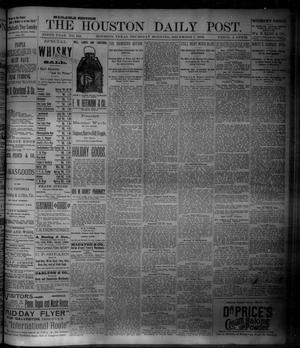
The Houston Daily Post was the morning edition, so Uncle Jack's obituary appeared on February 20th. It was nearly identical to the Chronicle's text. It, too, lacked any clue as to cause of death. Still, I decided to scan the previous week's editions.

The Post had a story about the same shooting as The Chronicle—no other shootings were reported. But The Post did have something new—a Mortuary Report. Each Sunday the paper listed how many died during the previous week. The list was by name and, and it featured causes of death. I'd found the report in the Sunday edition the week before Uncle Jack's death. So, I quickly rolled forward to February 25th.

Twice I looked through the issue before I found it. The small report was buried deep in the inside column just right of the gutter and near the bottom of the page. But the report was there and so was Uncle Jack. His name, his age, where he lay, and, now, how he died were no longer questions to which I sought answers.

By diving into family lore I’d tasted a bit of history while learning a bit about my heritage. More importantly, I was fortunate to have visited with a family member I'd never met before. I am now convinced of one other thing, the next conversation with my aunt should be very, very interesting.

Tuesday, January 5, 2021

God's Gift of Humor

 By Ellen Connelly


A few summers ago St. Peter's had a summer film festival where several of us were asked to come on a Wednesday evening and show our favorite film. It seemed to me to be a very simple, straightforward assignment with no strings attached.  A few days before I was scheduled to make my appearance I overheard Fr. Stockton telling someone about it, and was just short of horrified to learn that the presenter would be leading a discussion with the audience about the religious significance of the film they’d chosen. If you’ve seen Waking Ned Devine you undoubtedly appreciate my concern. (If you haven’t seen it, go rent it) This film includes gambling, nudity, profanity, lying, and sex. (It also includes some spectacular scenery.) It’s one of the funniest movies I’ve ever watched, but probably not what I’d have picked had I realized what was expected.

I tend to enjoy movies and books for the story and have never been good at or enjoyed searching for hidden meanings, nor do I need to find significance in everything ... I’m not likely to be the person who will see the Virgin Mary in a pancake. So this was a real challenge. It was only after viewing the DVD several times, and enjoying it every time, that I felt I’d discovered the message: GOD WANTS US TO LAUGH.

That’s not a conclusion you would come to by reading the Bible. It only mentions laughter forty-two times. (I didn’t count. That’s from Wikipedia). Most of the time laughter is mentioned in Holy Writ it is derisive, as in Psalm 37, “ The Lord laughs at the wicked”, or cynical, as in Genesis when Abraham and Sarah both laugh at the notion they could become parents in their nineties. We even read in Ecclesiastes 7:3 that, “Sorrow is better than laughter, for by sadness of face the heart is made glad.” 

The Bible does talk a lot about joy, but not about any hearty belly laughs. (Unless you count Abraham falling flat on his face when he got the message of his impending fatherhood.)

But does that mean that God has no sense of humor? Surely He must have. Why else would He have given the dog a tail? In Psalm 104, a magnificent paean of praise for all He created, we read that he made whales just to play in the sea. The God who turned water into wine at a wedding obviously wanted people to enjoy themselves. Life includes both sorrow and joy, and just as tears may be our answer to sorrow, laughter is our response to joy. Joy and laughter are good for us. In Proverbs, we read, “A cheerful heart is a good medicine, but a downcast spirit dries up the bones.” 

As I continued to search for something that would explain the religious significance of Waking Ned Devine, I came across this prayer by Edward Hays. It says it all.
“ Father and God of Fools, Lord of clowns and smiling saints, I rejoice in this playful prayer that you are a God of laughter and of tears. Blessed are you, for you have rooted within me the gifts of humor, lightheartedness and mirth. With jokes and comedy you cause my heart to sing as laughter is made to flow out of me. I am grateful that your son, Jesus, who was this world’s master wit, daily invites me to be a fool for your sake, to embrace the madness of your prophets, holy people and saints. I delight in that holy madness which becomes the very medicine to heal the chaos of the cosmos since it calls each of us out of the hum-drumness of life into joy, adventure, and, most of all, freedom. I, who am so tempted to barter my freedom for tiny speckles of honor and power, am filled with gratitude that your son’s very life has reminded me to value only love, the communion with other persons and with you, and to balance honor with humor. With circus bands and organ grinders, with fools, clowns, court jesters and comics, with high-spirited angels and saints, I too join the fun and foolishness of life, so that your holy laughter may ring out to the edges of the universe. 
Blessed are you, Lord my God, who invites me to be a holy fool.”

Amen

_________________________

Ellen Connelly is a most faithful Christian and wonderful aunt. She lived many years in Kerrville, Texas but has since moved to a smaller community outside of San Antonio. Each summer we visit and part of the annual ritual is movie night. Aunt Ellen has a knack for picking gems that even young great-nephews will enjoy. It is with her permission that I post this blog entry. (Originally posted 8.27.2012

Tuesday, December 29, 2020

Talk of the South

The other day a friend was pent up and tense, so I said something like, “You’re wound tighter than Dick’s hatband.” She froze and then proceeded to laugh.

More and more I catch myself using such expressions—in particular the ones my Mom or Dad used—which are common here in the South, but likely nowhere else. And to be clear, there are subdialects in the South that may be as different as Texas from Georgia, and certainly, Louisiana has more than one subdialect. Still, there are commonalities (scroll down after this post to see a list). As a young man, I’d have pitched a hissy fit if you told me I spoke like my parents. For you transplants from the North or other geographies, “hissy fits” are akin to tantrums. In contrast, “conniption fits” are going postal. Technically speaking, you never "have" either a hissy or conniption fit—you "pitch" them.

My three brothers and I rarely sent Mom into a conniption fit. When we did, however, her face turned red and her eyes burned like flares. She followed her growl through gnashed teeth with a demonic, “hellfire damnation!” That’s when we scattered for the hills, baby. Mom rarely used anything past “gosh!”.

But I digress. Parental-based expressions in our speech are not uncommon. Why we tend to do this as we get older is simply part of genetic continuity—as well as comfort. That’s especially true for those of us who are parents. Sometimes we go with default programming because kids tax your brain to the limit, and that programming comes from our parents. The perpetual, “Because I said so,” is a good example. The Southern version is simply, “Cuz I said so, that’s why!” Southerners like dramatic emphasis when they argue with their kids—it provides finality.

Of course, some things you just never let go of, despite your age. The iconic Southernism, “y’all” is one. However, usage differs for singular and plural. The singular is “y’all” whereas the plural is “all y’all.”

I uttered another ism when my middle son and I were replacing a flush valve in a toilet—good father and son time for Texas boys. Once we got 'er done I looked at Will with a smile and said, “Good enough for govement work, son.” I’d hear my Dad say that whenever he finished a repair. And, yes, down here the R and middle N are silent when speaking the term, "government." 

"Fix" is a quirky term, too. It can mean “to repair,” although more commonly it is used as an adverb—qualifying an action, such as, “I’m fixin’ to do the lawn,” or, “I’m fixin to go to work.” As well, “fixin” can be a noun when you add an S. “I got some fixins for the hamburgers and hot dogs.” Of course, you use fixins to “doctor” your food—that one I got from my grandmother on my mama’s side.

Family relations bring another ism into the conversation. Shaking hands with a senior Southerner, more often a woman than a man, you might be asked, “So who are your people?” That’s not an ethnic reference, simply a weird way of asking about your family lineage. Like a Klingon, you are who your family is.

You should also note that Southerners often refer to themselves in the plural. We don’t know why—maybe it stems from a limited gene pool in our rural past, or it’s just something unexplained and belonging in the X-files (Black Mirror for you twenty-somethings) of human behavior.

Southerners certainly have more isms and idiosyncrasies than Carter has little liver pills—that much I can say. These things seem to bind generations no matter how metropolitan our southern cities become or advanced we think we are. Both my parents were educated and, yet, they could sometimes sound as if they were from the sticks. Maybe that’s the secret: That Southernisms are like grandma’s pie—comfort food. When everything moves at warp speed—just kick your shoes off, set a spell, and get to jawin with a good friend or kin.

All y’all take care now, ya hear!


Note: This column originally appeared in the Bellaire Examiner, 27 June 2007.


Southernisms

A Southerner knows the difference between a hissy fit and a conniption fit, and
that you don't "HAVE" them, you "PITCH" them.

Only a Southerner knows how many fish, collard greens, turnip greens, peas,
beans, etc., make up "a mess."  

Only a Southerner can show or point out to you the general direction of
"yonder."

Only a Southerner knows exactly how long "directly" is, - as in: "Going to town,
be back directly."

Even Southern babies know that "Gimme some sugar" is not a request for the
a white, granular sweet substance that sits in a pretty little bowl in the middle
of the table.

All Southerners know exactly when "by and by" is. They might not use the term,
but they know the concept well.

Only a Southerner knows instinctively that the best gesture of solace for a
neighbor who's got trouble is a plate of hot fried chicken and a big bowl of cold potato salad. If the neighbor's trouble is a real crisis, they also know to add a large banana puddin'!

Only Southerners grow up knowing the difference between "right near" and "a
right far piece." They also know that "just down the road" can be 1 mile or 20.

Only a Southerner, both knows and understands, the difference between a redneck,
a good ol' boy, and po' white trash.

No true Southerner would ever assume that the car with the flashing turn signal
is actually going to make a turn.

A Southerner knows that "fixin'" can be used as a noun, a verb, or an adverb.

Only Southerners make friends while standing in lines, and when we're "in line,"
. . . we talk to everybody!

Put 100 Southerners in a room and half of them will discover they're related,
even if only by marriage.

In the South, y'all is singular, .... all y'all is plural.

Southerners know grits come from corn and how to eat them.

Every Southerner knows tomatoes with eggs, bacon, grits, and coffee are
perfectly wonderful; that red eye gravy is also a breakfast food; and that fried
green tomatoes are not a breakfast food.

When you hear someone say, "Well, I caught myself lookin'," you know you are in
the presence of a genuine Southerner!

Only true Southerners say "sweet tea" and "sweet milk." Sweet tea indicates the need for sugar and lots of it - we do not like our tea unsweetened. "Sweet milk"
means you don't want buttermilk.

And a true Southerner knows you don't scream obscenities at little old ladies who drive 30 MPH on the freeway. You just say, "Bless her heart," . . . and go
your own way.

And to those of you who are still having a hard time understanding all this
Southern stuff, - bless your hearts, I hear they're fixin' to have classes on
Southernness as a second language!

And for those that are not from the South but have lived here for a long time,
all y'all need a sign to hang on y'alls front porch that reads "I ain't from the
South, but I got here as fast as I could."


Friday, September 11, 2020

We Remember

Disasters, like any event, have attributes derived from the sting that holds each event in our memories. Their impact can be such that they instill a wariness in our collective DNA. And, sometimes those can fade as the generation that lived the experience passes on. An example is Pearl Harbor. That generation is all but gone. We remember December 7th as a nation, but few are left that can recall the surprise of an unprovoked and deceptive attack; the horror of wholesale destruction that cost 2,403 livesboth military and civilian, along with images of smoldering remnants of a once-proud fleet at anchor; and the ensuing fear that followed for months in anticipation of an Imperial Japanese invasion on the mainland. 

USS Arizona ablaze. Public domain.
My father served in World War II, so much of the wartime feelings he shared stay with me. I've certainly passed much of that on to my sons, but will their children even acknowledge the event ever happened
or understand what led to it and its lasting impact on current foreign policy? 

Hard to say.

More locally, Galveston, Texas recently observed the anniversary of the worst natural disaster to strike the United Statesthe 1900 storm that virtually wiped much Galveston off the map. Estimates put fatalities somewhere between 6,000 and 12,000. Much of the country is ignorant of that event but Texans, particularly those who live along the Gulf Coast, well understand the meaning and caution of that moment in history. A completely unsuspecting and unprepared population lie in the path of a horrific storm. It unleashed biblical damage and death from massive storm surge and winds. Imagine a struggle for survival so intense, so horrifying, that your entire personality might change as a consequence. 

Broadway Ave. Rosenberg Library
The next day, survivors emerged from the wreckagethe ruin. Few structures remained intact. Corpses, both human and animal, were everywhere. Disease, stench, starvation, and depression hovered a once-thriving metropolis anticipated to one day rival Manhatten. Gone--never to recover its fleeting glory. No one is left to give a first-person account of that night. We learn from diaries, interviews, and images. Still, when clouds gather in the Gulf, the memory stirs within. There've been subtle reminders from nature--Hurricane Carla in 1961, Hurricanes Rita and Katrina in 2005, Ike in 2008, and Harvey in 2017. Most recently, Laura in 2020. So in this case, we can imagine to some degree and identify with devastation.

Today we remember 911another manmade surprise. Another out-of-the-blue disaster no one saw coming. It shares attributes most notably with Pearl Harbor. Lives lost were 2,977and one might argue everyone an innocent. Like Pearl Harbor, 911 is a part of our foreign policy DNA. We are mortified by appalling images: People plunging to their deaths; towers aflame and collapsing on those in the streets below; a smoldering maw in the Pentagon; and a crater with remnants of Flight 93, not to mention the gut-wrenching recordings to loved ones before the crash. This one is still fresh in our collective memory. 

For each disaster, an iconic image emerges. For 911, the World Trade Center towers symbolize the day, in particular, the moment right before a second plane strikes one tower while the other spews flame and smoke from the prior collision. This now gives earlier pictures of the towers a ghostly, morbid feel. For the 1900 storm, one image stands outGresham's Castle, a virtually lone standing structure ruin and timber from an entire island laid waste. And, of course, Pearl Harbor leaves us with its indelible image of a mutilated battleship Arizona engulfed in black smoke and flames.

I started this intent on a completely different direction. Well, that was abandoned. So if this is going anywhere, maybe it's simply this: These events and images symbolize the worstthe worst in nature, the worst in ourselves. But then, on the flip side, comes the best in ourselves. Because humankind is really never at its best unless things are at their absolute worst. And that is worth remembering.

Tuesday, June 23, 2020

The Road Rules


Summer is here and with COVID-19 scaring people away from flying, households everywhere are considering road trips to anywhere and everywhere. Well, at least to wherever COVID-19 is not. I wrote this for a column years ago and thought it was timely to dust it off. My sons were all elementary school-age then, so I hope you'll forgive the nostalgia. F

For your consideration...

It’s old school, but my wife and I have always thought the TVs with DVDs built into SUVs or the advent of mind-numbing portable video games take away from the fun of road-trips. The road to anywhere is an adventure and the going is entertainment. Like my Dad used to do, we load up with igloos, snack bags, and tunes. Yes, tunes—CDs and smartphone adaptors (no Bluetooth then).

Once we’re geared-up we pull onto the open road in the Suburban. Back in the day, it was the family Galaxy 500 and we were headed for someplace as close as my grandmother's farm just outside of Chapel Hill; and sometimes that meant places as far away as Jackson Hole, Wyoming. Dad drove us there without a TomTom or other navigation aid. He traversed the highway system with a nose for direction and maybe a road map.

My wife and I have three sons. So we prepare for the fact that road-trips immediately trigger hunger in the human male, which is why my wife is sure to always pack large amounts of munchies. Road-rations include, but are not limited to Pringles, Chex-Mix, beef jerky, crackers, fruit snacks, and assorted sandwiches, and nearly all will disappear before reaching the county line. Actually, food serves as a sedative. After the boys eat, they each fall into a food coma for an hour or two.

When the boys wake up, the immediate discussion center on where we are, or where we are headed. The boys are into double-digit ages, so the road games and sing-alongs aren’t as popular as they used to be. Still, they happen now and again. But more often than not we just have good conversations.

The adventure wasn’t much different when I was a kid, although there were no satellite radios, CD’s, or iPods. So on long trips between towns of any size, we had AM radio because FM radio only went about 75 miles—at night under clear skies, if we were lucky. Yeah, the farm reports were really exciting between Amarillo and Raton Pass on the Colorado/New Mexico border.

Essentially, you were out of touch. It was a primitive time before cell phones. At best, you had a Citizen's Band (CB) radio mounted under your dashboard. A wire ran from the CB, under the front seat, up along the door and out a cracked window to a whip antenna magnetically held to the metal roof of your car. The speaker might crackle as you heard someone named “Bandit” or “Rubber Duck” say, "Breaker, breaker—come back." That was code for “hello, anyone there?” Talking on a CB made everybody sound like a redneck. You added an extra southern drawl to your speech, even if you were from New Jersey.

The airwaves were filled with slang like, "What's yer twenty?" or "That's a big ten-four, good buddy, I gotta pull over for a ten-twenty at that-there choke n' puke!" Translations: "What is your location" and, "OK friend, I have to go to the bathroom at this restaurant."

The codes were no secret–everybody knew them. It was just fun to hear the conversations among people who would never met face-to-face. CB radios were a reflection of the road-trip culture of those days. All these things combined to make any trip an event—connecting us to other people in other cars from other places.

Take away the cell phones or even the CBs of the seventies and driving in and of itself still has codes or a language all its own. This is especially true in the heart of Texas country roads. Headlights, for instance, are channels of communications—more so back in the day before radar detectors. But when you saw a car coming up the highway with its lights on during the day, you could count on seeing a State Trooper or sheriff a mile or two down the road just ready to write you a ticket. These days that’s a bit diluted because most car models have running lights illuminated day or night.

At night, however, the code for an impending speed trap is a few flashes of the hi-beams. How do you know the other driver isn’t signaling that you’re driving with your brights on? Well, most cars these days have auto dim on their headlights. Even so, if you know for sure your brights aren’t on and a driver is flashing his—the law is around the next bend waiting to introduce himself.

Day or night there is one signal a lot of people don’t know these days—and they should. This mostly applies on four-lane highways, but it can on two-lanes with a shoulder. When a car comes up behind you flashing its hi-beams, it is a signal for you to move to the right-hand lane. In other words, get out of the way because you are going too slow for the left-hand lane. The passing driver also owes you a wave, thanking you for your courtesy.

Speaking of waves

Once you get onto the farm to market and county roads, things often downshift to a decidedly different pace. You know the routine, right. We city folk like driving pedal-to-the-metal—if the speed limit is 60 we’re pushing 69-1/2 miles an hour (if not more). Life in the country, however, rarely strapped with the yoke of need-it-yesterday deadlines. So things happen in seasons, and that means our rural brethren will often do 50 in a 60 with an elbow resting out an open window.

My dad was a country boy. And while on the open highway he could cruise pretty quickly, once on the country roads he instantly defaulted to his more relaxed heritage, whistling a Bing Crosby tune while hanging a cigarette out the vent window. And one thing I picked up from driving with him a lot as a kid was the wave.

The wave is simple while as subtle in complexities not unlike a Japanese bow. It is just what it sounds like—a flick of the wrist hand gesture between drivers as they drive past each other typically on a two-lane road. Two fingers casually raised is a courteous acknowledgment—hello. A full-on raise of the hand is hello to someone you recognize. Combine your wave with a tap on the brakes and you have what equated to a drive-by hug.

Road trips in America are rich experiences if you turn off some of the technology and let them happen. Pick a place near or far, pack up the buggy, and hit the blacktops. And when you do, keep yer ears on good buddy and I’ll catch you on the flipside—ten-4!

Friday, June 19, 2020

Gift of the Immortals

Father’s Day is one of my favorite days of the year. The day is special because it’s about so much more than being a dad, than about getting the quirky gifts the boys may make, or being served coffee in bed and hanging out with the guys watching some Sunday marathon on TV. Certainly, my children—my sons—are at the very heart of it, but not for the reasons you might think.

My father died in late April many years ago, less than two months after my wife and I married. Even then, on that first Father’s Day without Dad around, I figured out that I hadn’t lost him. But now it’s just obvious. 

In the beginning, my brothers and I would all point out “dadisms” in each other. One of us would do or say something in a manner Dad used to. That provided a lot of private jokes and comedy, and it’s also when I got it. Then it was reinforced in spades when my sons were born. Pieces of us continue—even beyond the simple genes. 

For example, my youngest has a hearing loss in one ear. He never met my dad but when he is on the phone, he holds the receiver exactly the way my dad used to—and my dad had a hearing loss. Now as I get older and my hearing muffles a bit, I too find myself holding phone receivers at a slightly off angle to help clear the sound. It makes me smile when I see my son doing it or I catch myself. 

My oldest probably has the most pronounced manifestation of Dad's spirit. When he is mad, he looks just like Dad—his rigid composure, his stern facial expressions, and his stubbornness. When we disagree, his expressions and inflections sometimes remind me of those times Dad and I argued. He also has a similar chuckle and Dad’s ears. 

Then there is my middle boy. He is a bit turned inward as Dad could be sometimes. He thinks about things, and even broods, but doesn’t necessarily share what’s on his mind. One cool thing, he's as easygoing as Dad was.

Men have a tendency to measure themselves by their fathers—wanting to either be like them or wholly different. So finding those traits within yourself or from your children is up to individual opinion on whether they are good or bad. The trick is knowing how to embrace those traits and make them positive, or just laughing at them. Still, one thing is clear, our fathers live on in us—we never really lose them. That’s the father’s gift to his son—and one worth celebrating.

Thursday, May 7, 2020

Get Hired by Volunteering

You’ve been laid off and it stinks, but it’s done and your first move is to move on—don’t lament over the event. And one of the most important strategies to employ is staying busy while you’re navigating the wilderness of unemployed status. Sure, you have to update and refine your resume. The same goes for your LinkedIn profile and, if you have them, your Twitter and Facebook pages. But once you’ve done all that, and, of course, uploaded your new info to every career site and company career platform you can find, what next? What comes after all that and the networking emails or calls to every person you’ve ever met?

Volunteering.

Giving of your time and abilities to a worthy cause does a lot of things to help you find your next working gig. First, it’s just a good thing to do—and it never hurts to bank some good karma. Doing something charitable also makes you feel good, which keeps you positive and helps people around you stay positive about you, too. Attitude is key while unemployed and, it comes through during job interviews.

Second, volunteering enables you to hone skills. For example, volunteer organizations are excellent testbeds for leadership, because there is no greater challenge than successfully leading those people who are in no way obligated or beholding to you. Philanthropic efforts can also help develop other skills not required by your last job. Take on a large project to hone project management abilities, or seize the opportunity to take on a task that is outside your comfort zone.

While this writer has a boisterous personality, client meetings and presentations were sources of petrifying stage fright. After having served as a cubmaster to a pack of about 120 boys and their families, requiring service as master of ceremonies for campfires, award ceremonies, devotionals, and pack meetings, stage fright faded. Ultimately, presentations skills dramatically improved, which fostered other public speaking opportunities.

A third benefit to working with other volunteers is the networking opportunity. You meet people you might not have encountered before. And they get to see you and how you perform, potentially serving as references and sources of openings not advertised.

All in all, volunteering is a win-win-win activity when you are in between jobs. It’s in every way a constructive strategy with more than one beneficial outcome. Stay on top of your resume and other job search tasks, but definitely find a worthy cause to support with your skills and time. And quickly enough, things will come full circle.

Friday, April 20, 2018

Hero of the Revolution

This is the final in a series of excerpts from Sheer Will: the Story of the Port of Houston and the Houston Ship Channel, highlighting the roles of Galveston Bay and Buffalo Bayou in the birth of the Texas Republic.

Fate, fortune, Providence, or whatever it was shined its light on the Texians and their struggle. It shown brightest where the Buffalo Bayou and the San Jacinto River converge. The Battle of San Jacinto is a commonly told story in Texas. And while it has earned its place in military history—being one of the most decisive outcomes of any battle in history—it shares aspects with another historic battle in ancient Greece. General Sam Houston attacked the Mexicans at approximately 4:30 pm on 21 April 1836. He picked the time to attack for specific reasons. First, it was unconventional for the era. Attacks were usually formed up in the early morning, resulting in mid-morning battles. Houston, however, waited for the sun to move just above the hill from where his forces would charge—burning in the face of the Mexicans. And, Santa Anna’s men still lingered in their tents from their midday rest. None of the Mexican generals expected any action.

A few thousand years before, Themistocles, the Athenian general, performed a late-day naval attack against the Persians in narrow waters not far from Thermopylae. Both Houston and Themistocles attacked superior forces late in the day, inflicting heavy losses on their enemy. Unlike Themistocles, however, Houston’s victory resolved the issue between Texas and Mexico. An 18-minute fight sent Santa Anna fleeing the battlefield on horseback, and what was left of his army fell captive to Houston’s men.

Map detailing the San Jacinto battlefield.
The revolution is noteworthy in the Port of Houston tale because the events surrounding the final weeks of conflict all centered on Buffalo Bayou. It had become a crucial lifeline for the provisional government and the primary link to fortified Galveston (the unneeded last stand). Sam Houston’s triumph had further shed light on the value and viability of the bayou as an avenue between the Texas interior and the outside world. No longer was the Buffalo an obscure stream oozing its way through uncharted jungle. It was a hero of the revolution.

Monday, April 2, 2018

Destiny Takes a Hand

This is the third in a series of excerpts from Sheer Will: the Story of the Port of Houston and the Houston Ship Channel, highlighting the roles of Gavleston Bay and Buffalo Bayou in the birth of the Texas Republic.

One of the first things that helped turn the tide of war against Santa Anna was that one of the ships of the makeshift Texas Navy, the Invincible, went back to early Texas roots and pulled a "Laffite." In other words, the Invincible and her crew assaulted and seized the ship Pocket in an act of piracy. Texians picked the Pocket clean of its cargo that was originally bound for the Mexican army moving across the Texas prairie. That caused one of the splinters of Santa Anna’s overall force to slow down. What’s more, the supplies were sent to Harrisburg in order to help the people in the refugee camps that were popping up all along Buffalo Bayou. The sudden swell of population strained the resident population of Harrisburg, too.  So the food and supplies were a welcome relief. Additionally, ammunition recovered from the Pocket went to fortifications underway on Galveston Island. The final insult was the Pocket itself—she became a ship of the line for the Texas navy.

Another item history glosses over is the capture of the Mexican couriers by General Houston’s scout, Deaf Smith. Smith encountered and ran down the couriers on a patch of ground that is now Bellaire, Texas—a small city surrounded by the Houston metropolis. During the revolution, it was a combination of open prairie and patches of trees and brush clinging to the banks of Brays Bayou. The bounty of Smith’s acquisition is a turning point in history because the information obtained in the pouches of the couriers convinced Houston it was time to stop, turn, and fight. His men were already fired up for a scuffle with Santa Anna, and the fact that the couriers were using the monogrammed saddlebags of William Barrett Travis, the martyred commander of the now fallen Alamo, just threw gasoline on the flames.

By the third week in April, Santa Anna’s force of about 1,000 men marched through the Buffalo Bayou area; he was in hot pursuit of the Texas provisional government. He thought that if he captured them and executed them for treason, the whole insurrection would be over. Upon arrival in Harrisburg, Santa Anna found that the provisional government was gone; he’d just missed them by hours. They had escaped down Buffalo Bayou aboard the Cayuga. Furious, Santa Anna sent a patrol of horsemen stampeding after them. Circumstances favored the rebel government because even when the patrol came upon President Burnet in a canoe and paddling his way out to the Cayuga, they didn’t recognize him and went on about their frantic search for the fugitive government.

Sunday, March 18, 2018

Buccaneers, Bushwhackers, and Other Weird Connections

This is the second in a series of excerpts from Sheer Will: the Story of the Port of Houston and the Houston Ship Channel, highlighting the roles of Gavleston Bay and Buffalo Bayou in the birth of the Texas Republic.

Texas history is an ensemble cast of some really divergent characters. One of them is perhaps the most lovable rogue in all of piracy—Jean Laffite. He came into the Texas epoch as one of many pirates marauding ships in the Gulf of Mexico. Laffite was quite well known in his day, and much to the chagrin of Andrew Jackson, then president of a very young United States avidly defending itself from an England still stinging from an embarrassing defeat by the colonials. Laffite was a crucial ally during the Battle of New Orleans in the War of 1812 when the British tried and end run invasion through Louisiana. Suffice it to say that Laffite helped Jackson backhand the British. But that's not the interesting part.

Lafitte (L) is introduced to President Jackson (R).
Lafitte gets credited with historical dibs on envisioning the commercial benefits of Galveston Bay and its feeder bayous. During the Mexican War of Independence, Laffite acted as a spy for the Spanish government. At least that was his cover story. As such, he headquartered himself on Galveston Island—then little more than the summer home for the native Karankoawa tribe, as well as a camp for Louis-Michel Aury. Aury was Laffite’s pirate competitor and a spy for the embattled Republic of Mexico. Laffite liberated the island from Aury sometime around 1817. Thus Galveston became Laffite’s homebase from which he raided ships in the Gulf and ran a smuggling operation between Galveston and New Orleans.

One historical footnote: Laffite’s smuggling network included the infamous bushwhacker, Jim Bowie. Bowie was a well-known slave trader and Jean Laffite's partner before his martyrdom 18 years later at the Alamo. They used the various bayous, hidden rivers, and streams of East Texas to smuggle slaves into the United States. Laffite eventually left Texas behind for opportunities elsewhere, and less pressure and prying by the United States. But before all that, he'd have a lasting impact on region and all of Texas. 

What makes Laffite’s role so crucial is its timing. Spain and the young American republic were squabbling over territorial boundaries resulting from the Louisiana Purchase—including what are now east Texas and the upper Texas Gulf Coast. In the middle of the whole thing, supporters of the exiled Napoleon decided to colonize the lower banks of the Trinity River that emptied into Galveston Bay. You remember Napoleon—the more than naughty little emperor of France with a penchant for invading everyone around him. Naturally when Napoleonic supporters show up in the backyard, one is apt to raise an eyebrow. 

In response to the perceived French squatters, a skittish United States charged an emissary by the name of George Graham with warning off the trespassers. Spain, in the meantime, ramped up its military force and dispatched troops to the Trinity River. While this set up seems a lit fuse to a powder keg of three opposing parties, it fizzled pretty quickly. By the time Graham and the Spanish troops converged on the bay area, the Napoleonic colonials had already abandoned their plans—actually they seemed to just disappear. It was all much ado about nothing. But, the foray did result in Graham’s fortuitous meeting with Laffite.

An 1827 map illustrates what a mystery the Texas coast was. 

Most of Texas, including the coast, was virtually unknown. Maps were so off the mark that Galveston Bay was represented as barely more than an inlet. Some maps even omitted Galveston Island. Consequently, George Graham got a big surprise during his visit with Lafitte. From their first moments, Graham realized that the entire bay area constituted a potential, if not probable heart for commerce—a large safe harbor with various rivers and bayous offering access to the interior of Texas. In fact, Graham saw that it was a key to Texas. Of course, Galveston Bay and its tributaries were not without their hazards. They were a mix of ever-changing tangles and shifting sandbars, populated by sometimes friendly natives (and other times not so friendly), pirates and privateers, along with intrepid souls willing to make their isolated homesteads in dense thickets and vast prairies. Still, when Graham reported back to Washington D.C., he was emphatic that if pirates and freebooters could overcome such obstacles, imagine what legitimate private enterprise and a free citizenry might accomplish.

So, how does all this factor into the weeks building to the fight for Texas independence? That'll be covered next time.